
Business Management
- Basics for Entrepreneurs
Revised 17 October 2026
Key words: Logic first in business studies, Business Management, Business Analyses, Liquidity, Cash flows, Cash flow 1, Cash flow 2, Cashflow 3, BayWa Group analysis, IFRS 18, Cash flow statement, Costs-Benefits, Contribution Margin, Business Planning, Liquidity Planning, Double-entry accounting without debit/credit
Why this website ?
My aim is to present business performance figures in a way that is easy for entrepreneurs, supervisory board members, students, and other interested parties to understand.
Using the same terms in business analysis and planning breaks down barriers.
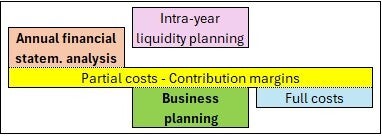
Profitability, liquidity and stability are at the core of every business. Hopefully, I can convince you that there are topics related to it that your textbooks don't cover.
- Periodic liquidity: Prefer cash flows that are closest to the work of accountants !
- Double-entry theory: Debit and credit belong to a pre-digital accounting tradition.
- Over-indebtedness: Stop the illogical treatment required by that old convention.
- Variable and full costs: Should we use a company allocation sheet or projections?
- Liquidity planning: A supplementary, future-oriented cash flow is required.
- Planning of target alternatives or planning year-after-year: It is possible to switch.
Also interesting for entrepreneurs and members of supervisory boards:
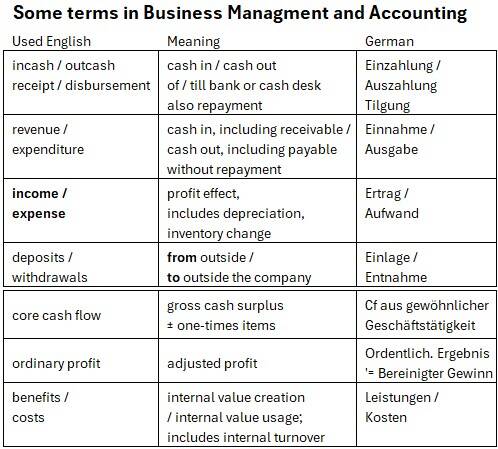
- Gross cash surplus: A profit and loss model exists that includes it.
- Ordinary profit: Doing adjustments while walking through the financial statement.
Other authors in the field of business management write about ideas, market opportunities, team guidance and so on. That's good. However, let us also look for performance indicators. Let's also search for time-saving analysis and programming.
The principle should be 'logic first'! In business management, however, you often encounter 'standards first' (e.g. IFRS 18 and commercial laws), 'conventions first' (e.g. debit/credit), or 'those who cry loudest first' (e.g. search engines).
There are two focuses
Firstly: The concept of 'self-financing capacity' is widely used. This concept is related to cash flow 1–3. The cash flow statement in IFRS 18 is the opposite. This can mislead supervisory boards, as was demonstrated by the BayWa group.
Secondly, there is double-entry accounting. After introducing digitisation, the basic principles can be taught using only the four account classes and checksums. I present a 'Double-entry Table'. With prepared examples, it takes only two hours to teach double-entry bookkeeping theory. You are invited to adapt this MS Excel table to your language and sector.
The bridge between accounting and cash flows
Bookkeeping will forever be based on the four classes of accounts - see page Double-entry Accounting.
The cascade of cash flows 1–3, together with depreciation as a metric, has four steps.
Profit accounts
→ Gross cash surplus → Cash flow 1
Private accounts
→ Adjusted deposits/withdrawals → Cash flow 2
Financial accounts
→ Sustainable repayments → Cash flow 3
Tangible asset accounts
→ Depreciation as a benchmark of Cash flow 3
Cash flow 3 is simply another word for 'self-financing capacity' or ‘cash flow for financing investments’ (in French: capacité d'autofinancement). This cash flow cascade has been known in the agricultural sector in German-speaking countries for more than 35 years. The logic is broader, however. In any business (and even in any household), you should ask: does it generate enough cash, can it meet its obligations, and can it reinvest without undermining stability?
Cash flow 3 and its benchmark were used to analyse the financial difficulties of the German BayWa Group. Question : Did their supervisory board receive the appropriate information? One section of this website then deals with IFRS 18.
The following sources do not all present the same approach. They are included here because they address related questions: self-financing capacity, accounting education, and the role of debit and credit in a digital environment. They demonstrate: I am not alone !
Global Voices on Cash flow & IFRS 18
- Agicap (France) — Self‑financing capacity determines investment ability.
- https://agicap.com/en-us/article/self-financing-capacity-definition-calculation/
- Anders (Germany) — IFRS 18 adds complexity without improving clarity.
- https://datenbank.nwb.de/Dokument/1043760/
- Beresford (Canada) — Cash‑flow standard‑setting is a ‘balancing act’, not a science.
- https://www.sfu.ca/~poitras/cash-flow-stmt-history.pdf
- Finance‑Online (Germany) — Criticism of IFRS continues.
- https://www.finance-magazin.de/finanzabteilung/bilanzierung/kritik-an-ifrs-reisst-nicht-ab-29782/
- Hossain et al. (Bangladesh) — IFRS education faces structural barriers. https://www.researchgate.net/publication/361546751_Accounting_students_perceptions_of_ the_barriers_to_studying_IFRS_in_the_accounting_curriculum
- Partners Finances (France) — Free cash flow must be interpreted carefully.
- https://www.partners-finances.fr/actualites/474-free-cash-flow-flux-tresorerie-disponible-suivre-evolution-besoin-financement
- Sahay (USA) — Cash flow statements often fail to support real analysis.
- https://doi.org/10.1007/978-3-030-91231-4_72
- Keum (South Korean Capital Market Institute, 2025) – Korean operating profit had "stronger value relevance, persistence, and predictive power for cash flows" than the one defined under IFRS 18.
- http://dx.doi.org/10.2139/ssrn.5443134
Global Voices on Digital Accounting
Theory researchers and practitioners worldwide question the necessity of teaching debit/credit and propose modern, digital approaches:
- Pincus (USA) — Debit/credit is not essential in introductory accounting.
- https://www.proquest.com/docview/210893454
- Rai & Sisneros (USA) — No pedagogical advantage from teaching debit/credit first.
- http://dx.doi.org/10.21511/afc.02(1).2018.02
- Warsono (Indonesia) — Revisits double‑entry from the accounting‑equation perspective. https://www.researchgate.net/publication/320912369_The_Accounting_Equation_and_Revisiting_the_Theory_of_Double-Entry_Bookkeeping
- Xavier (India) — Accounting without debit/credit is possible and teachable. https://www.flipkart.com/financial-accounting-analysis-without-debit-credit-revolutionary-innovation/p/itmefwq8ubgrkhzs
- Bookkeeping Studio (Australia) — Modern bookkeeping differs fundamentally from historical methods.
https://thebookkeepingstudio.com.au/bookkeeping/traditional-versus-modern-bookkeeping/
- Klever+ (USA) — Electronic calculation removed the burden of mental arithmetic.
https://www.linkedin.com/pulse/evolution-bookkeeping-from-old-school-ledgers-digital-marvels-ub9wf - Maple Hill Services (UK/India) — Traditional bookkeeping is largely historical.
https://www.maplehillservices.com/post/is-traditional-bookkeeping-a-bygone-era-now
For more basics, indicators, and examples about profitability, stability, benefits-costs, planning and accounting theory with debit/credit, see:
The section 9.2 of that file includes the debit/credit convention with 'T-accounts', etc. There is even a section on German commercial law (HGB) relating to bookkeeping.
Contents
• Why this website?
• About the author
• The core : Profitability. Liquidity. Stability
• Gross Cash Surplus -> Equity. Over-Indebtedness
- Gross Cash Surplus -> Profit
- Profit -> Ordinary Profit
- Assets – Debts = Equity
- Assets and Equity in an Over-Indebted Business
• Indicators for the core
Liquidity: Explaining Cash flows
- Cashflow 1-3: Closest to accountancy
- Comparison with other cash flows systems for analysis and planning
• Group BayWa Group analysis and IFRS 18
• Controlling. Costs-Benefits-Analysis. Contribution Margins
• Business Planning
- Liquidity planning with a supplemented cash flow
- Target alternatives vs. year-after-year
• Double-entry Accounting - based on Logic
• Legal notice and Declarations