The Core : Profitability - Liquidity - Stability
Entrepreneurs, analysts and supervisory members are asking:
- Is enough ordinary profit being generated to reward labour and capital?
- Is there enough cash available throughout the year?
- How stable is the existence basis, as evidenced by adjusted equity growth?
The company may appear to be profitable, but lack liquidity. Other questions:
- What about costs and benefits?
- What about decision-making ?
- What about short-term financial planning?
- What about medium-term operational planning?
The following diagram illustrates the topics covered in business management.
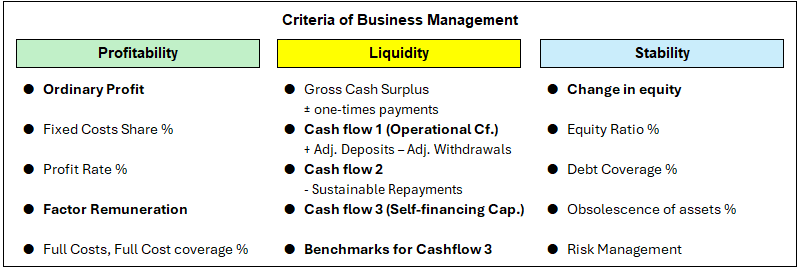
This table already shows 16 terms. However, there are many more. Therefore, it is necessary that teachers, consultants and AI select the most useful concepts: Logic first.
Here is another diagram which is close to the workflow of Business Management.

In this diagram, the horizontal arrows at the top indicate the 'direct method' for determining 'cash flow 3'. This can be tracked throughout the year.
Once the annual financial statements for a given year have been finalised, the 'indirect method' via ordinary profit can also be used.
Instructors should provide an overview similar to these diagrams in their first few lessons. The reason behind: Many of the students drop out of their business management course after a few weeks. Nevertheless, some of them become politicians, while others find themselves suddenly elected to the supervisory board of a large company or group. Even those with limited business management knowledge should be aware that profitability, liquidity and stability are three of the most important economic concepts.
For « Important pairs of terms » see the relevant section in the file
‘Business Management - Basics, Indicators, Examples.pdf’
Accountants have a different mindset than entrepreneurs.
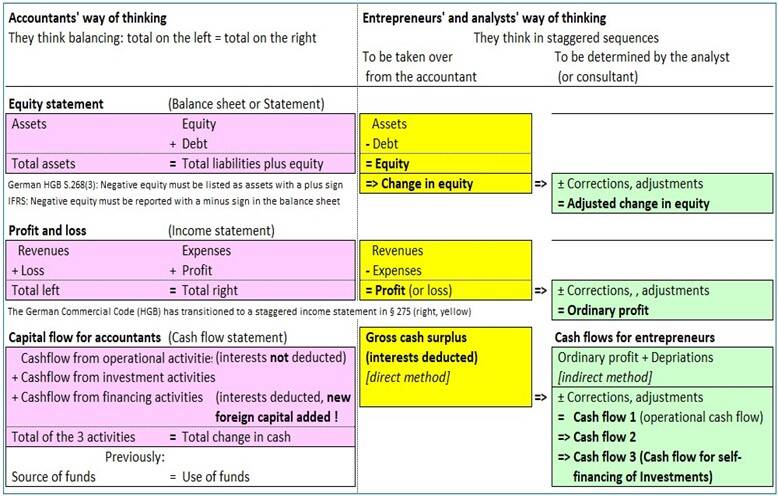
Accountants record facts. Analysts and entrepreneurs interpret them.
In large companies or groups, the supervisory board is responsible for identifying concepts that demonstrate current performance. Therefore, they should have a similar mindset to entrepreneurs. Cash-flow analysis requires a different mindset as bookkeepers have.