From Gross Cash Surplus to Equity and Over-indebtedness
The annual financial statement always includes two sections:
- The profit and loss statement (P&L).
- The balance sheet.
For entrepreneurs, the P&L takes precedence.
Gross Cash Surplus – Profit - Ordinary Profit
The P&L sequence shown in the following table is used in German agricultural accounting. It contains four columns. The author has only separated the presentation of the totals into four lines for easier reading.
- Revenues and expenditures (payments) end with gross cash surplus.
- Income and expenses end with profit.
- Ordinary Profit is the analyst's result after economic adjustments.
- The gross cash surplus is also the starting point for cash flows - if the 'direct method' is applied.
Gross cash surplus is the difference between recorded cash-related revenues and payments or expenditures. It can be followed during the financial year, before final depreciation, inventory valuation, and other year-end adjustments. It is therefore an important starting point for monitoring periodic liquidity and deriving Cash Flow 1
Depreciation must be calculated in accordance with tax or commercial law. This leaves considerable scope for tax advisers to be creative. This is why cash flows often provide a more honest picture of a company's financial situation than profits do.
Pay attention to changes in inventory: an increase in unsold stock may increase accounting profit without increasing current cash receipts. Gross cash surplus therefore helps reveal the difference between cash generation and period profit.
⭐ Beware of False Friends:
In English income is not profit. Income minus expenses affects profit.
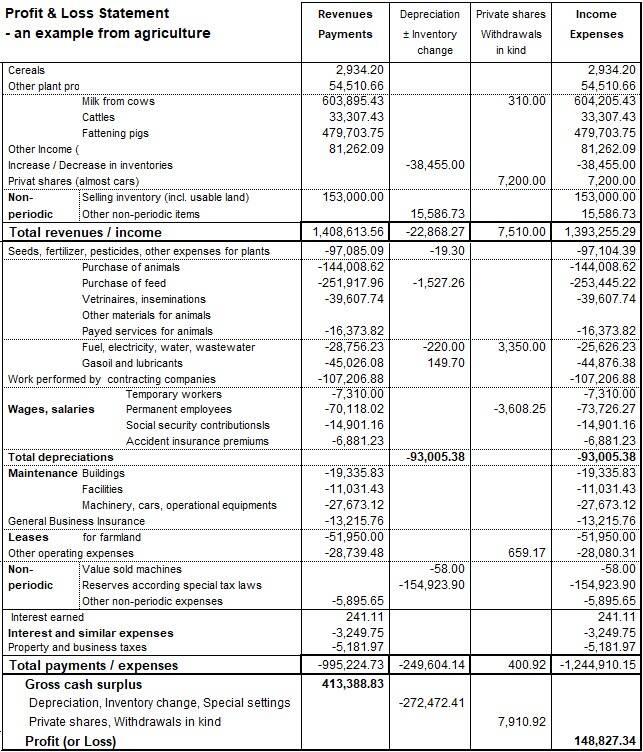
This farm which employs five full-time labourers, has a depreciation value of over 93,000 euros. That's quite a lot in relation to profit, isn’t it?
In the examined year, land (where other people want to build houses) was sold for 150,000 euros. Of course, this is an extraordinary amount of cash. German law permits such revenue to be sheltered from tax for reinvestment (in land or buildings) within about two years. See second column.
Why derive the "ordinary profit" already here ?
It's due to the practitioner's advantages. In the author's program for analysing and planning JUP PS, you can automatically import the accountant's figures for three or five years. For each year, an adjustment column is provided allowing you to start analysing immediately. See the following table.
Advantages:
- Regarding lines, the analyst can make adjustments simultaneously!
- The adjustment column ends up with the 'ordinary profit'.
- The adjustment column can also be used for reallocations.
Not all the adjustments can be made automatically. Even in times of the artificial Intelligence (AI) the human analysts are demanded.
- The analyst's key task is to identify the necessary adjustments.
Look at the adjustment column in the following table. One example:
In a family business, the son of the owners may receive wages that the accountant records in his ledgers.
However, from an economic viewpoint, you need to know how much ordinary profit is left for the entire family. As shown in the following table, €33,071 of wages are deducted. They are transferred to private (personal) withdrawals.
The JUP PS software neutralises automatically the sale of inventory. However, when it comes to the machines in your company, you may wish to consider whether that figure is truly one-time. Sometimes, specific items within a company can overwhelm programmes. In this case, some additional wording should be included in an advisory letter.
After adjustments, the track for ordinary profit is as follows:
Gross Cash Surplus → Profit → Ordinary Profit.
By the way, the first time I came across the 'adjustment column' was at the 'Betriebswirtschaftliches Büro' in Göttingen in 1973.
Note that in this presentation, the signs for expenses have been changed from minus to plus - for easier reading.
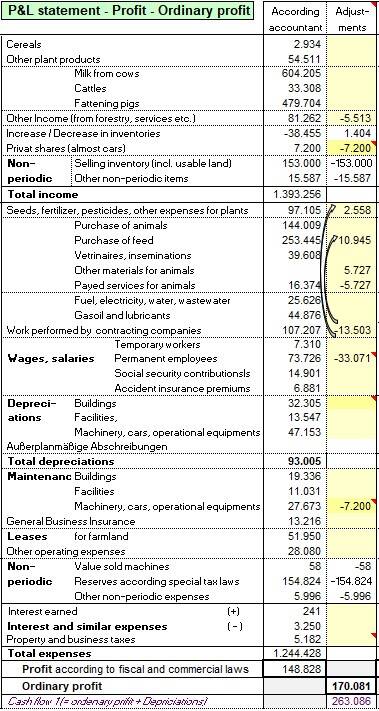
In the adjustment column, you can also see some reallocations (see the arrows). The analyst has indicated some incorrect encodings there. Such corrections in the lines are preparatory work for the cost-benefit analysis.
This table already shows the operational cash flow (cash flow 1), using the so-called practitioner's formula.
Operational cash flow = ordinary profit + depreciation
Adjustments on depreciation?
As you see on the farm example, the depreciation may have a very big impact. It is worth asking whether the depreciation shows a „normal level“. The aim is to quickly obtain reliable figures for the sustainable deterioration of assets.
In the long run, there are no significant differences between depreciation according to tax or commercial law and economic reasons. In this farm example, no adjustments were made.
Generally, you should examine the depreciations in individual years carefully.
Here are some explanations. In business management, depreciation is usually calculated linearly. However, according to tax rules, depreciation can generally be legally manipulated. For political reasons, it is often permitted to choose a 'degressive' method of depreciation. Furthermore, a reduction in acquisition costs may be permitted (e.g. for small companies). Companies may even legally transfer depreciation to a period before the time of investment.
However, then depreciation in later years is much reduced, meaning that later profits are artificially higher than they would be with linear depreciation!
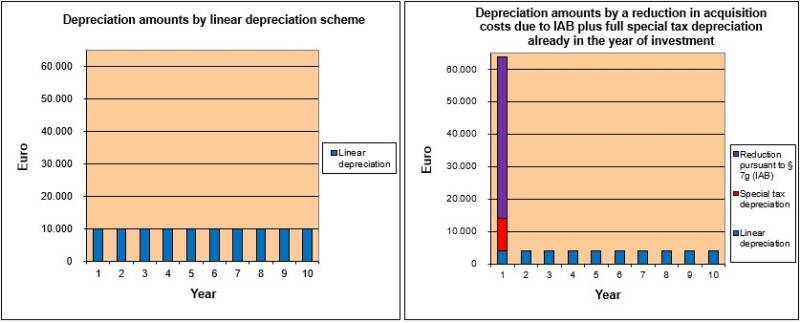
High depreciation can indicate a successful company's growth. However, if the investment has only been made to avoid taxes, this can lead to unbearable debt servicing costs.
Avoid disaster for the business's liquidity and stability!
Assets - debts - equity
Accountants' balance sheets must also be transferred into analysts' balance sheets, using adjustments according to economic rules. The basic formula in the balance sheet is:
Equity = Total Assets - Total Liabilities
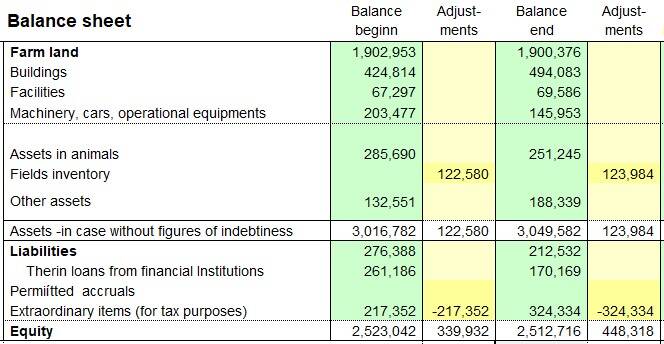
Is such a shortened balance sheet sufficient? Yes, it is. The analyst can make adjustments in these kinds of balance sheet, too. Each company is given a detailed balance sheet by its bookkeeping office. If the analyst has any questions, he can simply ask the entrepreneur.
Only a few adjustments were made to the farmer’s balance sheet shown here.
a) In Germany, there is an option to value the field inventory or not. However, economically, the field inventory has value, at least by the middle of the year (this is the balance sheet date for agriculture in Germany). Therefore, the analyst can add assets of around 123,000 euros for field inventory.
b) Regarding the extraordinary items (see the final lines of the figure), it is proposed that the entire amount is to be neutralised. In this farm example the adjustment column shows an additional equity : about plus €340,000 and plus €450,000 respectively.
In addition to P&L statement and balance sheet, every set of annual accounts must show gross investment, enabling analysts and the supervisory board to assess it.
Assets and equity in an over-indebted business
The convention of 'debit and credit' was invented during the era of mental arithmetic and first written down by Luca Pacioli in 1494. According to this convention, a negative number must never appear in a column of numbers.
This convention is also applied to balance sheets, where equity must not have a value of less than zero. To achieve a balance in an over-indebted company, you have to add the amount of debt that is not covered by assets to the assets side! This means that additional assets are created artificially.
Here are two tables for demonstration purposes.
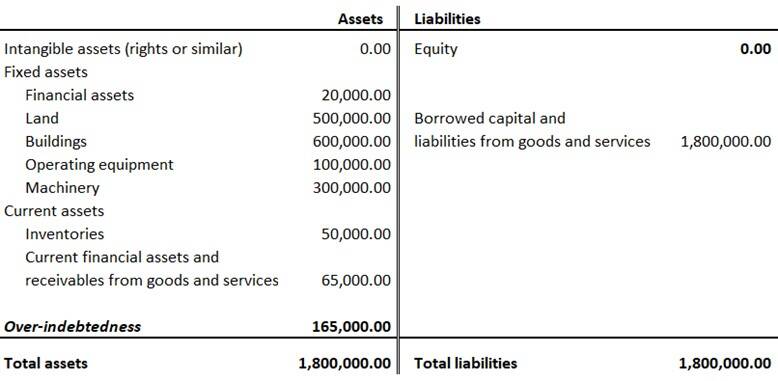
Now, digital arithmetic is in use, since the 1960s. Since then, a negative equity figure can also be shown in the balance sheet.
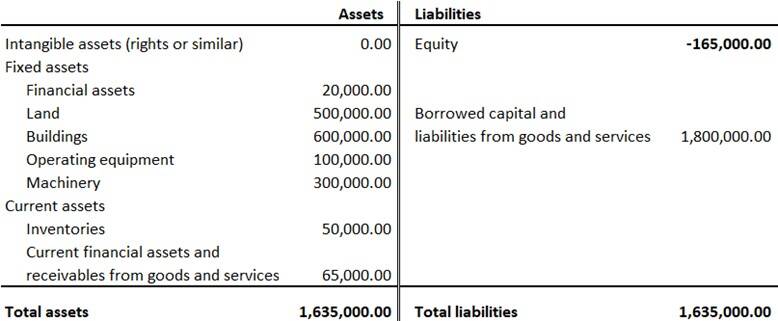
According to the "plus and minus" logic, the total assets are less than the total debts. This logic can and must replace the convention of "debit and credit". Furthermore, the national laws must recognise the consequences of digitalisation.