The BayWa Group analysis and the IFRS 18
In 2024, the author analysed the German BayWa Group using the concepts he otherwise employs to analyse companies. This group, which operates worldwide, is currently experiencing severe financial difficulties. The group's global workforce totals 22,000, according to the most recent figures.
The BayWa Group analysis
Findings :
1. The author found that the cash flow statement presented to the supervisory board did not help BayWa to avoid becoming illiquid.
2. The term 'cash flow for self-financing of investments' (cash flow 3) would have helped to avoid illiquidity. It works as an early warning system!
3. The author also found proof that staggered cash flows 1 to 3 are applicable to large companies, as well as to micro, small and medium-sized enterprises (MSME).
4. Much of the information provided to the BayWa Group's supervisory board and business journalists was about the 'cash flow statement'. In my analysis, the reporting presented to the supervisory board did not make the group’s sustainable repayment and reinvestment capacity sufficiently visible
For more informations about BayWa analyses download this file:
'Stop the "Three Activities" in IFRS 18.pdf'
The standard IFRS 18
'Standard' means 'norm'. In April 2024, the IASB published IFRS 18, stating that it would be introduced in January 2027. It should even be applied backwards in multi-year comparisons. Discussions about this project began in April 2016.
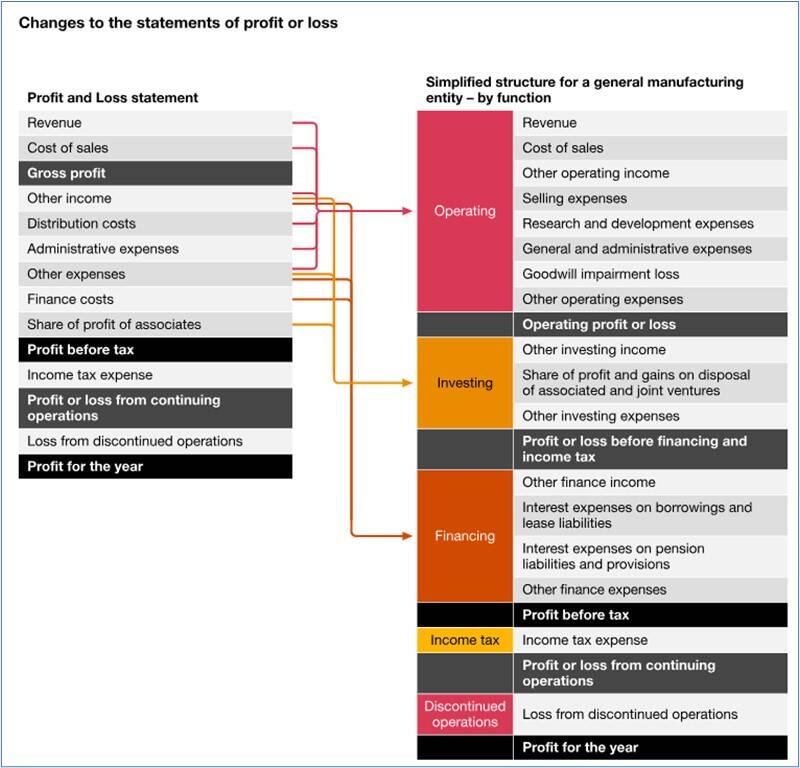
According to the IFRS 18, the income statement (P&L statement) will also be changed. In 2024, PwC (PricewaterhouseCoopers) published an overview of the changes to the income statement due to IFRS 18. PwC is one of the major auditing firms.[1]
[1] Glutting Verena. PwC Company (2024) IFRS 18: New regulations, consequences, implementation. PwC is the brand under which the member firms of PricewaterhouseCoopers International Limited (PwCIL) operate and provide professional services.
The Directors Academy in Hamburg, which claims to be the only multimedia portal for the training and further education of supervisory board members, published on
“IFRS 18: New Rules from 2027 – Action Required for Supervisory Boards“.[1]
“Items such as ‘Other’ are now only permitted in exceptional cases.
Management-defined Performance Measures (MPMs) must be explained in detail in the notes to the financial statements. MPMs are now subject to audit and are presented more transparently. Incorrect or misleading key figures can be identified more easily.
The quoted firm also explained:
“Goodwill must be disclosed separately on the balance sheet in future”.
Preventing fraud has always been a major challenge of bookkeeping. We will see to what extent the IFRS 18 can prevent fraud.
[1] https://directorsacademy.de/glossar/ifrs-18-neue-regeln-ab-2027-handlungsbedarf-fuer-aufsichtsraete/
Who are the so-called „standard-setters“ ?
There are probably accounting associations in all countries that deal with accounting standards. You will find them connected to governments.
More than 160 nations belong to the IASB (International Accounting Standards Board), an independent body organised under private law, with its headquarters in London. It publishes IAS (International Accounting Standards) and IFRS (International Financial Reporting Standards).
But the USA has never been a member of it. They have their own FASB (Financial Accounting Standards Board), which publishes the GAAP (Generally Accepted Accounting Principles). Worth mentioning: all such standardisation boards consist mainly of accountants, not of entrepreneurs.
Income statement according to IFRS 18 at a glance
- Income and expenses are classified into Operating, Investing and Financing categories.
- A new mandatory subtotal, Operating Profit, is introduced.
- Interest income and interest expenses are presented within the financing category.
- Management-defined performance measures (MPMs) must be reconciled to IFRS figures.
The last point I will not comment on. It is beyond my knowledge.
What is equal in IFRS and GAAP and what differs?
- Typically, the cash flow statement includes cash from new debts.
- Both the IASB and the FASB categorise the cash flow statement into three activities.
- Only the IFRS 18 separates also the income statement (profit & loss statement) into three categories of activity.
- In IFRS 18 the cash flow statement and the income statement, expenses for loan interest have been transferred out of operational activities. These are now deducted from financial activities, which journalists probably don't examine. This means – in my mind - that interest expenses will no longer reach journal readers. Obviously, readers only look for operating terms.
Certain groups and companies may prefer this change due to the IASB: Now, they can hide poor results more legally.
The US FASB still maintains that interest is part of operational activity. This will cause confusion with regard to US GAAP. Consequently, groups with subsidiaries in the USA and Canada must produce different income and cash flow statements! At least some states, such as Romania, Brazil and South Korea, want to continue using parts of their own systems. What a mess!!
What terms use professional evaluaters of companies?
The IASB itself emphasises IFRS 18 would lead to companies being valued more accurately. That is why the author conducted further research into how professional company evaluators estimate the value of a company or a group.
It was found that some professionals use equity rate or equity growth as the basis for their evaluations.
Other professional evaluators use a lot of terms that are already familiar from analyses.
In my research, none of the professionals takes cash flow statements into account !
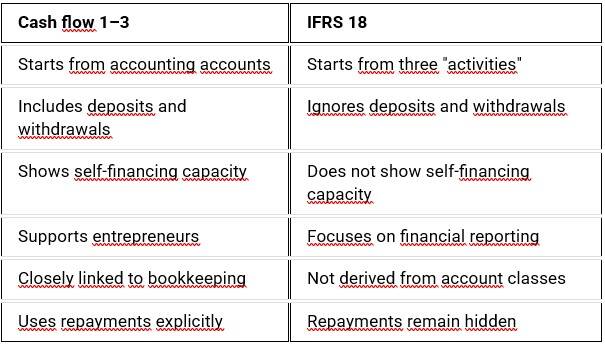
Here is a summary of cash flow 1-3 and IFRS 18.
What was first : ‘Self-financing capacity’ or ‘cash flow statement’?
In 1863, an American iron-producing company realised that, although they had made a good profit, they did not have enough cash to replace a blast furnace. This was due to high stock levels. This may have been the first cry for a term such as 'self-financing capacity'.
The concept of 'self-financing capacity' (capacité d'autofinancement) had already been developed by the French and English by 1970. In 1977, the author came across the term 'cash flow'. The World Bank calculated future-directed discounted cash flow based on the following formula:
Cash flow = Revenues - Operating expenses - Taxes - Interest - Repayments.
The oldest textbook in the author’s library that talks about cash flow was published in 1984. It defined analytical cash flow as follows:
Cash flow = profit + deposits – withdrawals + depreciation.
The book also stated that residual cash flow could be used to finance investments.[1]
Banks had previously introduced cash flows, also taking into account gross cash surplus. As the author recalls: In the 1980s, training institutes debated whether cash flows 1–3 should be determined using adjusted or unadjusted values.
Obviously, the accountants' boards developed their 'cash flow statement' without appreciating that terms relating to cash flow had already been introduced.
Accountants come from a completely different mindset.
Source of funds = use of funds.
The formula was central to ensuring that entries in manual bookkeeping were correct. This correction work has become obsolete due to digitalisation.
In 1971, the American FASB prescribed the 'cash flow statement' in their GAAP.
In 1988, the FASB divided the 'cash flow statement' into three activity categories.
In 1992, the worldwide operating IASB adopted this system.
With IFRS 18, however, the two accounting boards now differ significantly (see above).
[1] Leiber, Franz (ed) 1984 : Landwirtschaftliche Betriebswirtschaftslehre (Business Management for Agriculture), page 87.
Final remarks to IFRS 18
IFRS 18 has been developed for large companies and groups. However, it will undoubtedly trickle down to all businesses that are obliged to keep accounts.
The aim of IFRS 18 is not to provide useful information for entrepreneurs or supervisory board members. According to the IASB, the aim of IFRS 18 is to serve investors. Yet, professional valuers are not waiting for IFRS 18.
The 'cash flow statement' has never been a useful metric for entrepreneurs.
If you search the internet, you will find that 99 out of 100 results are related to IFRS 18 and the 'cash flow statement', but only one result differs from the official guidelines.
There are many descriptions of cash flows from training centres to be found on the internet. Often, the same websites offer new training courses dealing with IFRS 18. This suggests that some training providers are happy to see IFRS 18 as a new source of income.
In any case, it will never be possible to combine the three-layer 'cash flow statement' model with a cascade model such as 'self-financing capacity'.
Accountants are generally overwhelmed when it comes to cash flow. Their mindset is different. Don't get me wrong — accountants do a very important job. However, take accountants away from the responsibility for cash flows.
Even if teachers, counsellors and students spend only 10 or 30 minutes examining the income and cash flow statements in accordance with IFRS 18, this wastes a lot of time, costing the public sector millions of euros or dollars worldwide and in the European Union.
Ultimately, it will be entrepreneurs and companies who have to bear the direct implementation and training costs associated with IFRS 18, without deriving any benefit whatsoever from this accounting system
The author sees it like this: After a few years, it will be clear to everyone that the income and ash flow statements according to IFRS 18 need revising. The result will be chaos.
Good news for programmers
The analysis and planning programmes (such as JUP PS) can stick to their well-founded terms.
Only, the programmers must accept the changes in coding of entries. There will be new codes. That means even for programmers additional work. For what benefit?
The IFRS 18 in the European Union
According to its own EU laws, the EU Commission may only approve a new standard if the advantages outweigh the disadvantages. The EU Commission has to be advised by the European Financial Reporting Advisory Group (EFRAG). This is also a private non-profit association, located in Brussels.
Coordination is handled by FISMA (Financial Stability, Financial Services and Capital Markets). That belongs to the EU Commission itself.
The author sent several comments to Brussels. My article, 'Stop the three activities in IFRS 18.pdf', was submitted to the European Commission at the beginning of January 2025.
On 13 February 2026, EU Commission President Ursula von der Leyen signed the EU regulation on the IFRS 18 standard. This means that IFRS 18 is now legally binding in EU member states.
Only in autumn 2025, the EU Commission had announced a 100-day programme to reduce bureaucracy. But to my judgement, by approving IFRS 18, the EU Commission has created new bureaucracy.